
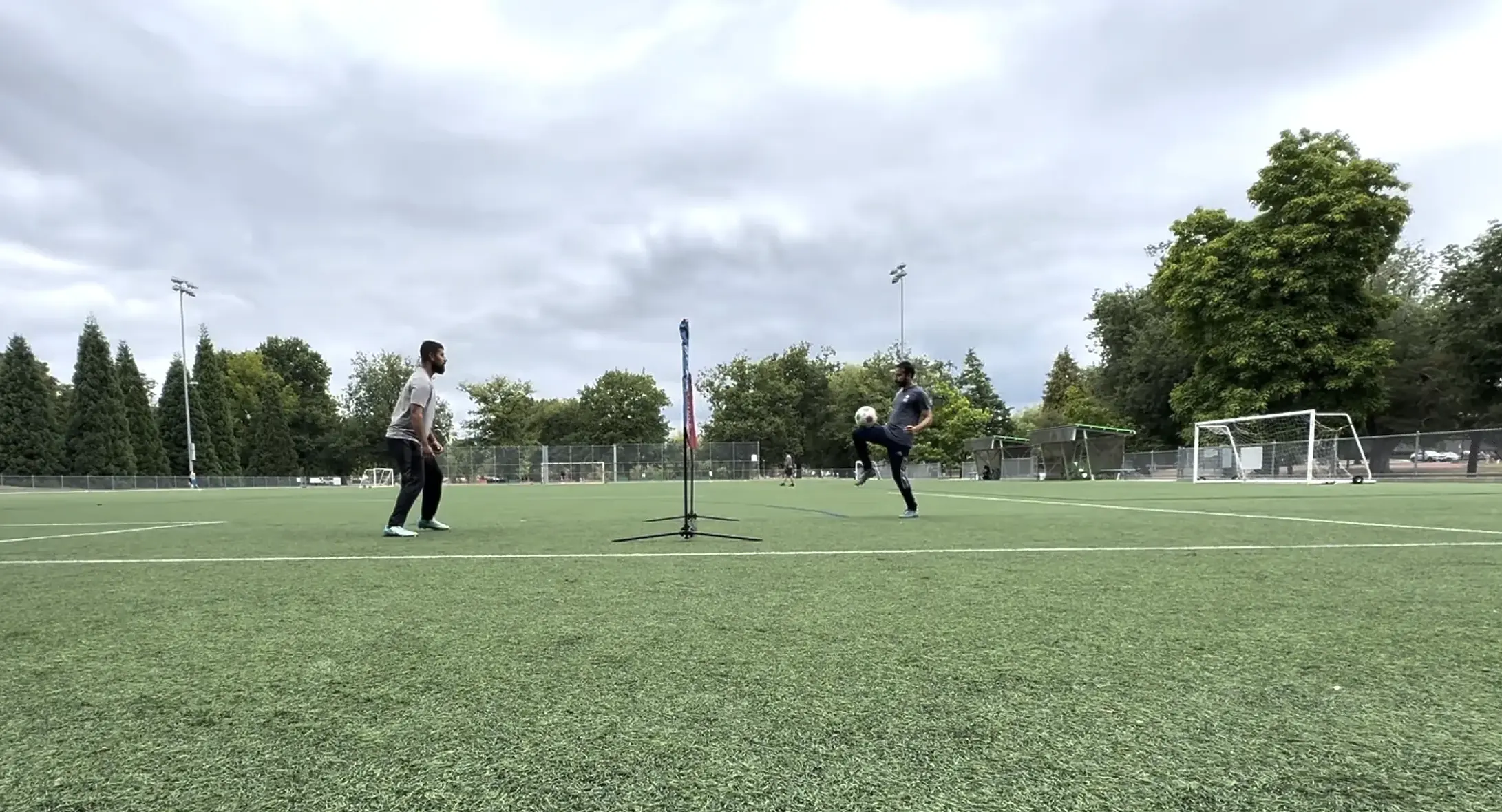
If you’ve been around our training sessions at South Van FC, you’ve probably seen a small net, a marked-out square, and a couple of players lighting up over a ball that never touches their hands. That’s soccer tennis, and it’s one of the simplest ways to build better touch outside of a full session.
It doesn’t need a full pitch, a full squad, or even a coach standing over it. Two players, a small space, and a bit of competitive spirit is enough. Here’s why we love it, how to set it up in your own backyard or driveway, and the rules to get your kids playing today.
What Is Soccer Tennis?
Soccer tennis is exactly what it sounds like. Take the format of tennis or volleyball, a net, a court, points scored by landing the ball in your opponent’s side, and play it entirely with your feet, thighs, chest, and head. No hands allowed, ever.
The ball gets served over the net and one bounce is allowed between touches. Most often we play with ulimited touches, to increase the challenge add a limited number of touches. It rewards a soft first touch and quick decision making far more than raw power, which is exactly the kind of habit we want young players building.
It’s been a staple warm-up and cooldown game for professional clubs for years, and for good reason. It’s fun enough that everyone asks to keep playing after training ends, which is the best sign a game is doing its job.
Here’s a clip of our coaches getting after it at training: watch on Instagram.
Why It Belongs in Every Training Routine
The biggest thing soccer tennis develops is first touch under pressure. Because the ball is often coming at an angle or with pace off a bounce, players have to control it cleanly and quickly, there’s no time to take a big touch and reset.
It also builds spatial awareness, reaction speed, and agility. Players learn to read where the ball is going before it arrives, adjust their body shape, and strike with different parts of the foot depending on the situation. That’s tactical awareness and physical coordination developing at the same time, without a coach ever needing to say a word about it.
And because it’s a game, not a drill, players stay engaged far longer than they would doing repetitive touches against a wall. Competitive scoring keeps intensity high, which means more quality reps in less time.
It’s low impact on the body too. There’s no heavy running or contact, so it’s a great option for a lighter training day, a recovery session, or just an extra twenty minutes at home between practices.
Setting Up Your Court
You genuinely don’t need much. A driveway, a patch of backyard, or even a quiet stretch of sidewalk works fine.
What you’ll need:
- A divider. A real soccer tennis or badminton net is ideal, but a rope tied between two chairs, a garden hose laid flat, or a line of cones all work as a stand-in. Set it between knee and waist height for younger players, lower than a volleyball net.
- A marked court. Cones, chalk, or whatever’s lying around. It doesn’t need to be exact, roughly the size of a small badminton court is plenty for two players.
- A lighter ball. A size 3 or 4 works best on a hard surface like a driveway, it’s easier to control in the air than a full-size ball.
That’s it. Once your kids know the rules below, they can set this up and run it themselves.
How to Play: The Rules
Here’s the version we teach at South Van FC to get players started. Keep it simple at first and add variations once they’ve got the basics down.
- Serve. The point starts striking it over the net into the opponent’s side, using any part of the body except the hands and arms. A bounce to serve is optional.
- One bounce. The ball is allowed to bounce once on your side before you must return it. It can also be played out of the air.
- Touch limit. Each side gets unlimited touches before the ball must go back over the net. Add limited number of touches to increase the challenge for players with experience.
- No hands. Feet, thighs, chest, and head only. This is non-negotiable and is the whole point of the game.
- Scoring. A point is won if the ball bounces twice on your opponent’s side, goes out of bounds, or if they fail to clear it back over the net.
- Play to 11. Standard games are played like a short tennis or volleyball set, first to 11 and win by two.
Quick reference for first-time players: unlimited touches per side, one bounce allowed, no hands ever, first to 11 wins.
Once the basics click, you can add variations. Try one-touch only for advanced players, restrict return shots to a certain part of the foot, or play 2v2 for a doubles version that adds a communication element.
Give It a Try
Soccer tennis is one of those rare training tools that’s genuinely fun and genuinely useful at the same time. It builds first touch, decision making, and coordination, and it does it through a game kids want to keep playing, not a drill they’re counting down to finish.
If you want more games like this built into a structured development plan, that’s exactly what we run in our academy at South Van FC. Reach out and we’ll walk you through how our programme works.
Harjit is the founder and academy director at South Van FC. He built the club from the ground up in South Vancouver with a focus on long-term player development. If you have questions about the programme or want to talk development, reach out at southvanfc@gmail.com.
South Van FC is a community football club based in South Vancouver, BC. We run a youth development academy and a VMSL Men’s team, built around one philosophy: develop real players, technically sharp, tactically aware, and mentally tough. Learn more at southvanfc.com.